
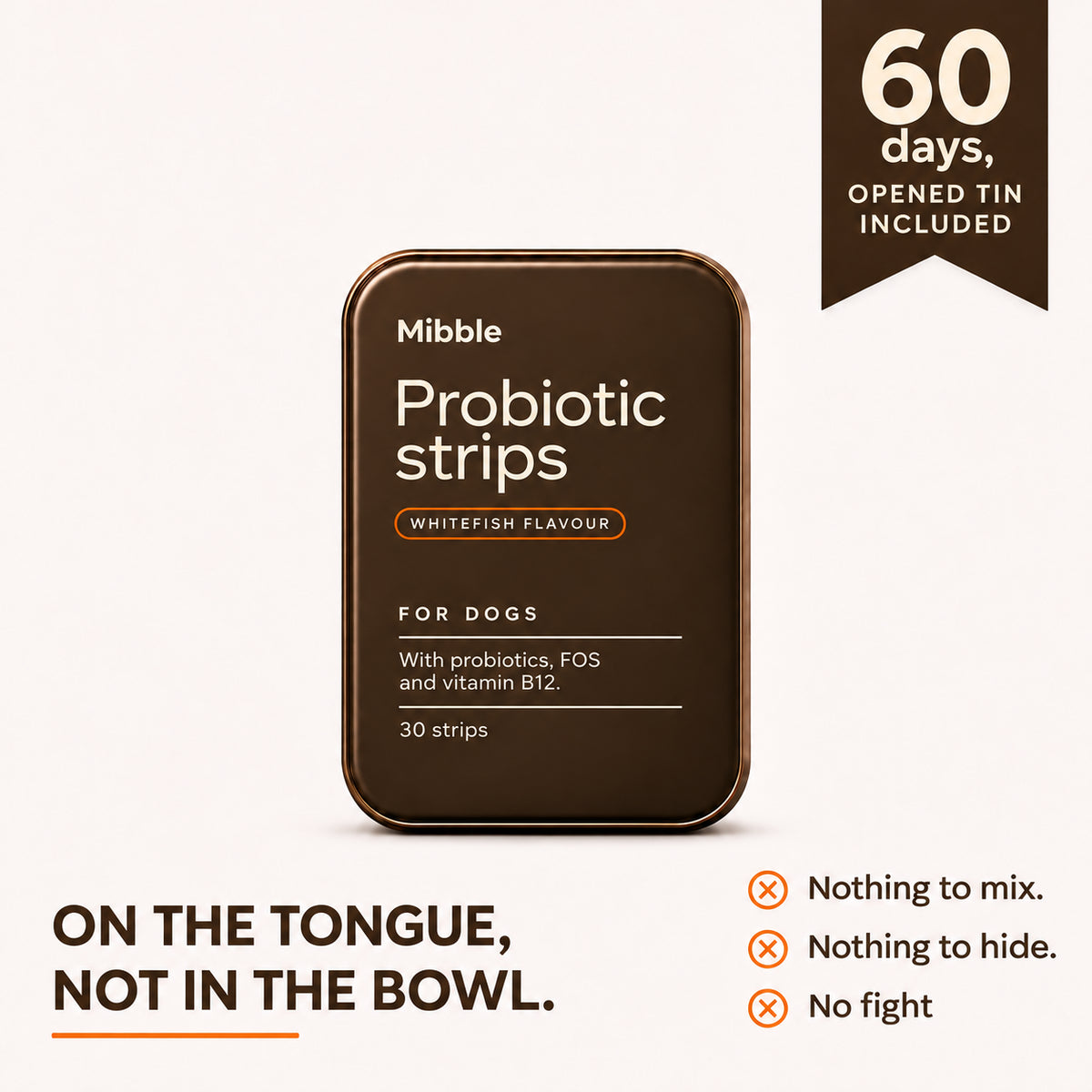


Daily Gut Health Strips
The vet-reviewed daily strip for firmer stools, less gas and a gut that holds steady.
- 3 organisms, 3 billion CFU
- All dogs, 8 weeks and up
- One strip. No bowl needed.
No subscription. Nothing to cancel, nothing that renews quietly.
guarantee
1–3 days
no beef
Serving Information
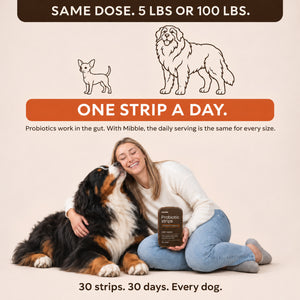
One strip a day, any size dog. On the tongue, or let him lick it off your fingers. It dissolves in a few seconds. No food required, which matters on the mornings he won't eat.
| Dog weight | Serving / day |
| Any weight | 1 strip |
| First week | every other day |
| During antibiotics | 1 strip, 2h apart |
Ingredients
Actives: Bacillus coagulans 1B CFU, Bacillus subtilis 1B CFU, Saccharomyces boulardii 1B CFU, fructooligosaccharides 25 mg, vitamin B12 50 mcg.
Other: pullulan, cellulose, MCT, natural whitefish flavour, lecithin, pectin. Nothing else.
Shipping & Guarantee
Ships in 1–3 business days, free in the US and UK.
If he won't take it, you're not stuck with a tin. Open it, try it, and if he turns his nose up, or if nothing changes, you get your money back for 60 days. The whole 60, not 27, because the flora takes about a month to move and a refund window that closes before then is a trick, not a guarantee.
1,284 owners, one bag at a time

Finally a bag that holds its shape.Mara

Three weeks and no more 3am wake-ups.Tom

Went from a 5 to a 2 on the chart.Priya

He eats it off my hand. No fight.Dan
The gas. I cannot stress this enough.Elena
Stopped the scooting on the rug.Chris

Gave it through his antibiotics. Nothing happened, which was the point.Sam

First supplement that told me what NOT to buy.Nadia
Finally a bag that holds its shape.Mara
Three weeks and no more 3am wake-ups.Tom
Went from a 5 to a 2 on the chart.Priya
He eats it off my hand. No fight.Dan
The gas. I cannot stress this enough.Elena
Stopped the scooting on the rug.Chris
Gave it through his antibiotics. Nothing happened, which was the point.Sam
First supplement that told me what NOT to buy.Nadia
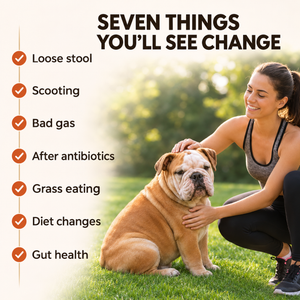
Five things owners actually notice.
Not what’s in it. What’s different three weeks later. These are the five changes that come up again and again, in the owners’ own words.
- No More Soft ServeIt's the word owners use for it, and it's the one thing you can actually see. Most start around a 4 or 5 on the chart and are aiming for a 2.
- No More ScootingGlands empty on their own when the stool is firm enough to press them on the way out. Firm the output and the dragging usually stops with it.
- Less GasA settled flora ferments less. It's the one the rest of the house notices before you've said anything about it.
- Gut Health and DigestionThree live organisms and a prebiotic fibre, working on the population that does the actual digesting rather than on the symptom.
- Nights You Sleep ThroughThe 3am whimper, the cold garden in a dressing gown, the crate to scrub at six. It's the complaint owners repeat more than any other, and it sits downstream of the same thing.
Most of them die before they arrive.
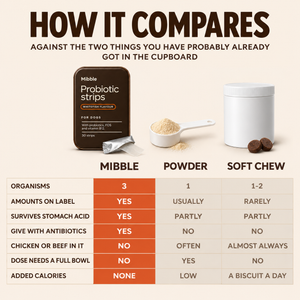
A dog’s stomach is acidic enough to kill the bacteria used in most products. That isn’t a scandal. It’s chemistry. It just means which strain you pick matters more than the number on the front of the tin.
We picked three built for the trip: two spore-formers that travel dormant and wake up downstream, and one yeast that antibiotics can’t kill.
You’ve done this before. Same curve, slower clock.
You already know this. It’s a food transition.
You’d never swap his kibble overnight. You do 25%, then 50%, then 75% over about ten days, because his gut needs time to catch up. Rush it and you pay for it on the carpet.
Rebuilding the flora is the same thing, just slower. You’re not giving a medicine. You’re running a transition. That’s why it takes weeks, not days, and it’s why stopping on day seven puts you back where you started.
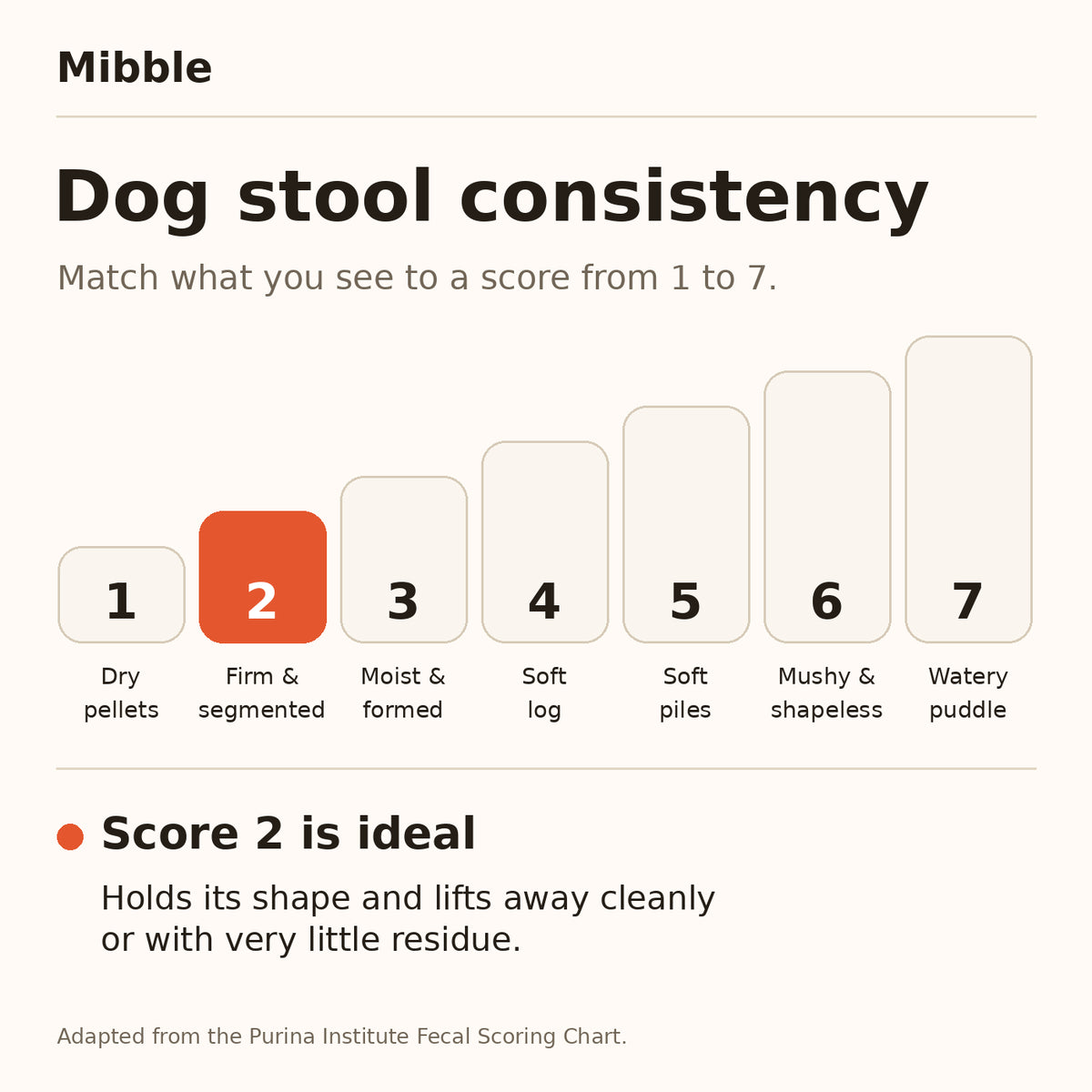
You already inspect the result twice a day.
Every tin ships with the 7-point chart vets use. Write down today’s number. Check again in three weeks. You don’t have to take our word for anything. You’re holding the evidence in a bag.
Same place, same mouthful. If he refuses one he refuses both, and after a few of those he starts checking every meal before he’ll touch it. Now you have two problems.
Three seconds, before the bowl goes down. If he spits it out, dinner is still dinner, and the bowl never becomes something he has to inspect.
A powder puts the dose and the dinner in the same place.
That’s the part nobody thinks about until it’s already happened. One bad mouthful doesn’t just cost you the supplement. It costs you his trust in the bowl, and that doesn’t come back quickly.
It also means the dose doesn’t depend on him finishing his food, which matters most on the mornings he won’t eat, and it adds almost no calories, so it still works for a dog whose vet has asked him to lose four pounds, where cheese, peanut butter and pill pockets are all off the table.
The Formulation
GS-01 is the name of our blend. Three organisms, two prebiotic supports, nothing else. It isn’t a patent or a study, it’s just a label so we don’t have to relist five ingredients every time. The strains and the counts are right here.
Bacillus coagulans (spore)1 Billion CFU
Bacillus subtilis (spore)1 Billion CFU
Saccharomyces boulardii1 Billion CFU
Fructooligosaccharides25 mg
Vitamin B1250 mcg
Other Ingredients
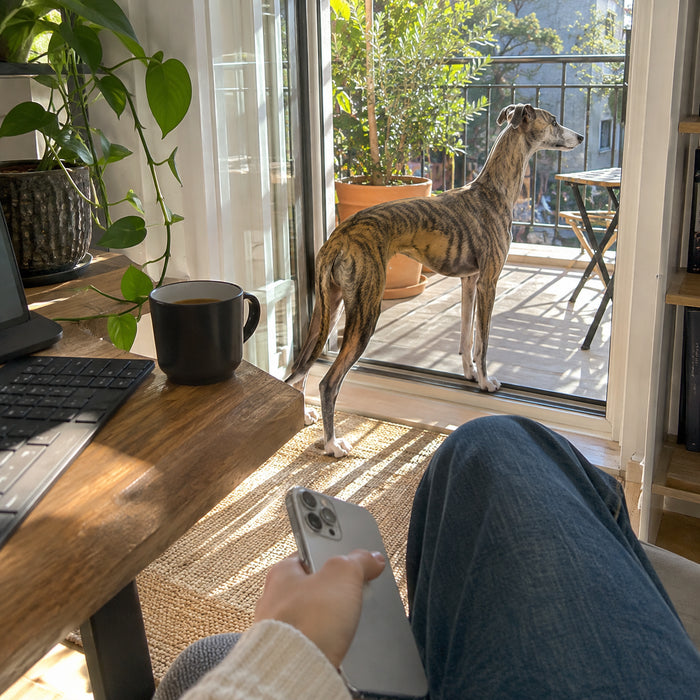
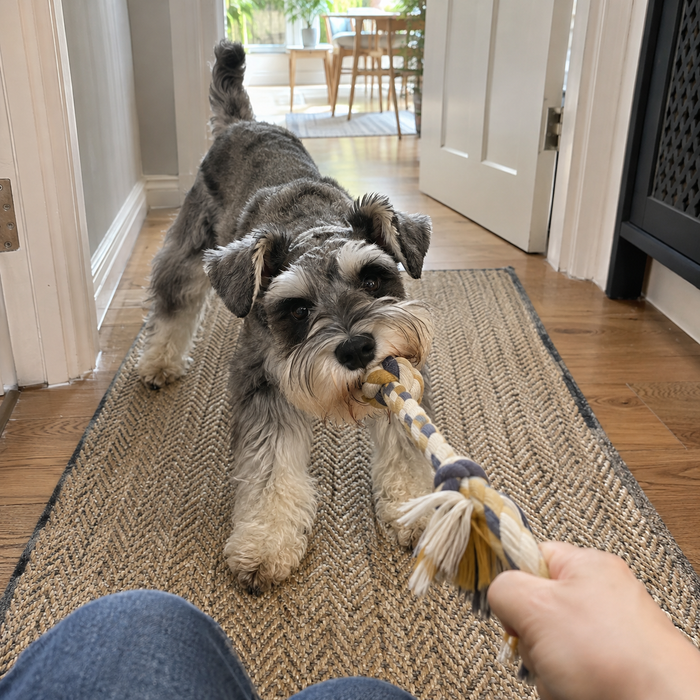
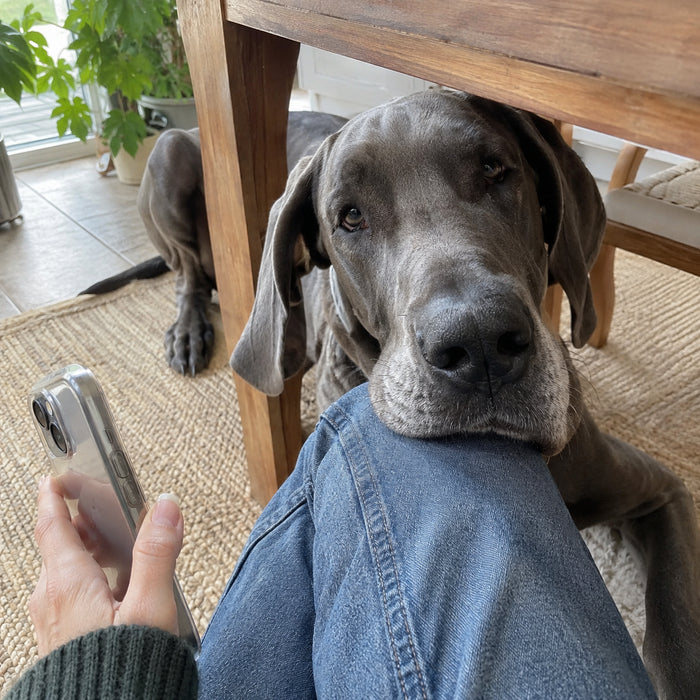
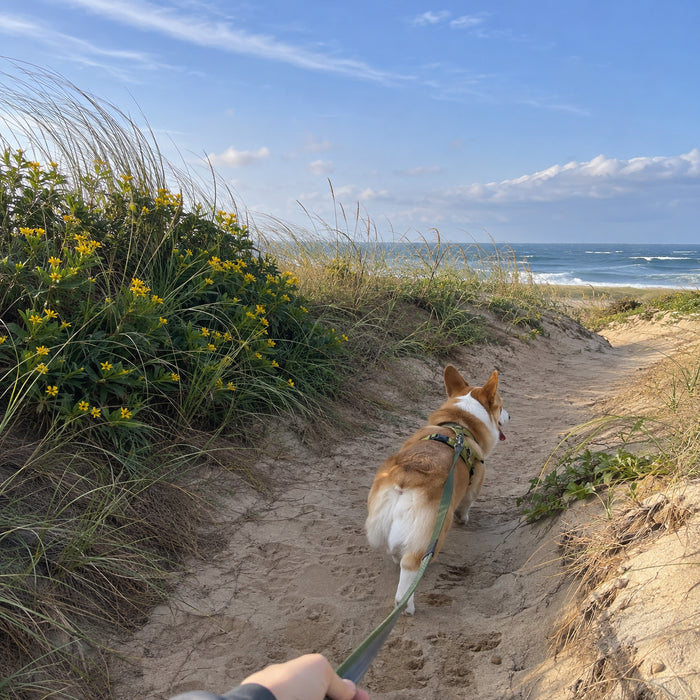
1,284 Owners Who Stopped Dreading the Morning Walk
Real bags, real carpets, real 3am wake-ups that stopped.




The questions we’d ask too.
Does the evidence actually support this?
The strongest evidence for probiotics in dogs covers exactly the situation most of our customers are in: shortening a bout of mild diarrhoea, and supporting the gut during and after a course of antibiotics. That's where the research sits, and that's what this was built for.
It's also strain-specific. The findings belong to particular organisms at particular doses, not to the word "probiotic" on a label. That's the part worth knowing when you compare products: if a tin won't tell you which strains are inside and how much of each, none of that research transfers to it. Ours are named, with the count printed beside each one.
I've already tried pumpkin and a vet probiotic.
Most of our customers have. Pumpkin is fibre. It changes the shape of a stool for a few days. The common vet powder is a single strain, and its own customers say it rebalances without firming. Different jobs. If one of them is working for your dog, keep it.
Why no chicken or beef flavour?
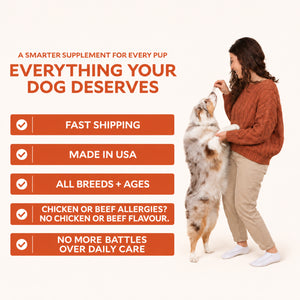
Because those are the two proteins dogs most often react to, and a gut supplement flavoured with the likely allergen is working against itself.
It worked, then stopped when I ran out.
That's the most common story in this category and it isn't a failure. It's what a microbiome does. It drifts back, which is why this is a daily thing rather than a course, and why the three-tin option exists: studies on dogs after antibiotics point to at least two months of rebuilding, and longer in some dogs. Three tins covers that with room to spare, inside the same window as the guarantee.
Probiotics have upset his stomach before.
That happens, and it's worth taking seriously. New flora really can mean a day or two of extra gas or looser stool while the old population and the new one sort themselves out. That's the transition, not a reaction. If that's happened to you before, run the first week every other day instead of daily, then go to daily from week two. A strip can't be split, so this is how you ease into it, and if it's still worse after a week, that isn't a settling period. Stop. You have 60 days to decide.
He's picky. What if he just refuses it?
Then you're not stuck with a tin. Open it, try it, and send it back inside 60 days. We'd rather eat that cost than have you gambling $34 on whether your dog cooperates. Two things do work in our favour: it's on the tongue in about three seconds rather than sitting in a bowl being inspected, and it's whitefish, so it doesn't smell like the chicken chew he's already decided against.
We're in the middle of an elimination diet trial.
Then wait, or ask your vet first. A strict hydrolysed-protein or novel-protein trial only works if nothing else goes in, and ours is flavoured with whitefish, which is a protein. We'd rather tell you that than sell you something that quietly ruins eight weeks of work. Come back when the trial is done.
Can I give it during a course of antibiotics?
Yes, and that's the point of including the yeast. Antibacterials work on bacteria; S. boulardii is a yeast, so there's nothing in that class for them to act on. Space it a couple of hours from the antibiotic dose anyway. It costs you nothing and it's the standard advice. Note what we're not saying: we're not claiming this prevents the relapse that so many owners describe a week or two after the course ends. The evidence supports support during and after a course. It doesn't support a promise.
Why is a strip more expensive than a chew?
It costs more to make: individually sealed, no filler, three organisms at a full dose each. What you're not paying for is three grams of flour, glycerine and chicken wrapped around a fraction of a dose.
The comparison that probably matters more is the one already in your budget. A gland expression runs about $20 and comes round again. A single vet visit for an upset stomach runs $85 just to be seen, and far more if anything gets tested. $34 a month sits inside that, not on top of it.
How do I cancel the subscription?
You don't. There isn't one. You buy a tin, or three, and that's the end of the transaction until you decide otherwise.
We know how this usually goes in our category, because its customers write about it constantly: the cancellation email nobody answers, the card charged after you cancelled, the "how about a lower rate instead" offer when you asked to stop. We'd rather you came back because it worked than because leaving was difficult.